Unlocking the Power of Multimodal AI: Real-Life Applications and Examples
Discover how multimodal AI is changing the game in various industries with real-life applications and examples.
Unlocking the Power of Multimodal AI: Real-Life Applications and Examples
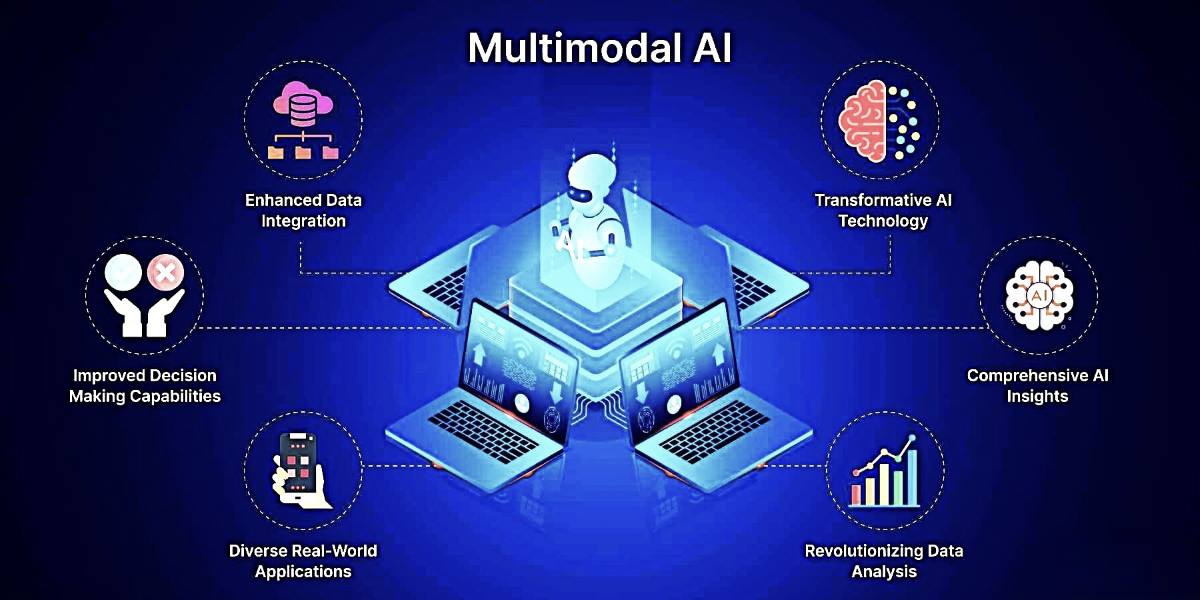
Multimodal AI, a subfield of artificial intelligence (AI), is revolutionizing the way we interact with machines. By combining multiple forms of data, such as text, images, and audio, multimodal AI enables machines to better understand and respond to human input. In this article, we'll delve into the world of multimodal AI and explore its real-life applications and examples.
Multimodal AI is not a new concept, but its popularity has grown significantly in recent years due to advancements in machine learning and deep learning techniques. The key idea behind multimodal AI is to integrate multiple data sources to improve the accuracy and effectiveness of AI models. For instance, a multimodal AI system can use both text and images to identify objects in a scene, or it can use speech and text to understand user queries.
One of the most significant advantages of multimodal AI is its ability to overcome the limitations of single-modal AI. Single-modal AI, which relies on a single data source, such as text or images, can be prone to errors and biases. Multimodal AI, on the other hand, can provide a more comprehensive understanding of the data, leading to more accurate and reliable results.
So, how is multimodal AI being used in real-life applications? Let's take a look at some examples:
1. Image and Text Recognition
Multimodal AI is being used in image and text recognition tasks, such as document scanning and image classification. For instance, a company called Google Cloud is using multimodal AI to improve the accuracy of its document scanning service. The service uses a combination of text and image recognition to identify and extract information from documents.
Another example is the use of multimodal AI in image classification tasks, such as identifying objects in a scene. Companies like NVIDIA and Microsoft are using multimodal AI to improve the accuracy of their image classification models. These models can identify objects, such as animals, vehicles, and buildings, with high accuracy.
2. Speech and Text Recognition
Multimodal AI is also being used in speech and text recognition tasks, such as voice assistants and chatbots. For instance, Amazon's Alexa and Google Assistant use multimodal AI to understand user queries and respond accordingly. The systems use a combination of speech and text recognition to identify user intent and provide relevant responses.
Another example is the use of multimodal AI in chatbots, which are being used in various industries, such as customer service and healthcare. Multimodal AI enables chatbots to understand user queries and respond with accurate and helpful information.
3. Multimodal Learning
Multimodal AI is also being used in multimodal learning, which involves training AI models on multiple data sources. For instance, researchers at the University of California, Berkeley, are using multimodal AI to develop a learning model that can learn from both text and images. The model can be used to improve the accuracy of image classification tasks and provide more comprehensive insights into the data.
Another example is the use of multimodal AI in multimodal learning tasks, such as learning from videos and text. Companies like Microsoft and NVIDIA are using multimodal AI to develop learning models that can learn from both videos and text. These models can be used to improve the accuracy of video classification tasks and provide more comprehensive insights into the data.
4. Multimodal Reasoning
Multimodal AI is also being used in multimodal reasoning, which involves using multiple data sources to reason about complex tasks. For instance, researchers at Stanford University are using multimodal AI to develop a reasoning model that can reason about both text and images. The model can be used to improve the accuracy of image classification tasks and provide more comprehensive insights into the data.
Another example is the use of multimodal AI in multimodal reasoning tasks, such as reasoning about videos and text. Companies like Google and Facebook are using multimodal AI to develop reasoning models that can reason about both videos and text. These models can be used to improve the accuracy of video classification tasks and provide more comprehensive insights into the data.
In conclusion, multimodal AI is a powerful tool that is being used in various industries to improve the accuracy and effectiveness of AI models. Its ability to combine multiple data sources makes it an ideal solution for complex tasks, such as image and text recognition, speech and text recognition, multimodal learning, and multimodal reasoning. As the field of AI continues to evolve, we can expect to see more innovative applications of multimodal AI in the future.
What's Your Reaction?